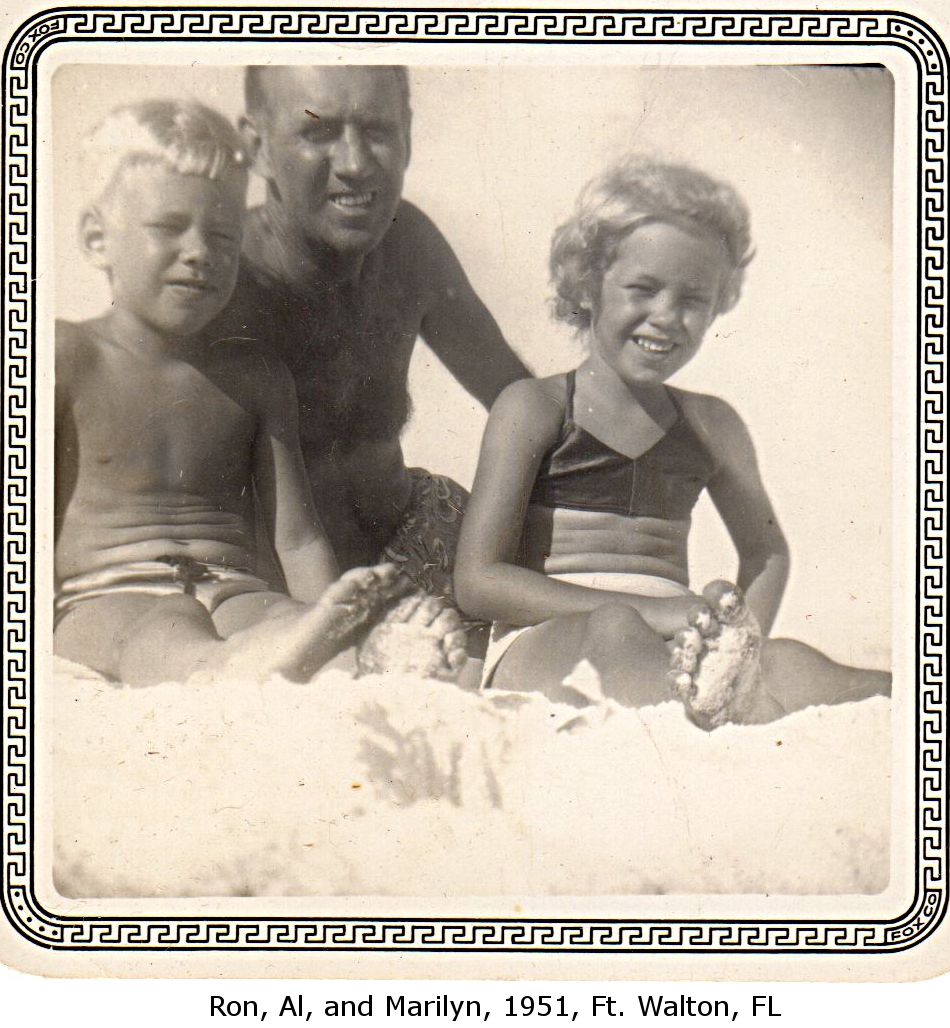
The 10 ft sand dunes were hills to me, covered in golden sea oats, while the beaches were clean white quartz sand, and the Gulf water was a sparkling, clear green color. This was paradise. At night we scooped up blue crabs in the shallow waters using lights. The crabs were kept on ice in Spanish moss overnight, and Cellie would cook them the next morning, dropping them into boiling water where they turned a bright red color. And each morning, as the sun rose, we walked the beach, catching big fat sand fleas to use as fishing bait and collecting seashells washed up during the previous night. We accumulated so many shells that we opened a seashell shop in our Crowley front yard, sort of like a lemonade stand with seashells. I remember Lloyd being stung by a Portuguese Man of War in the water and getting stabbed by a saltwater catfish that someone tossed to him. Some years later the sand dunes were bulldozed flat and the cottages demolished, replaced by modern-day condiminums, built of concrete and steel, without character or soul. All that remains are the memories of the way it was.
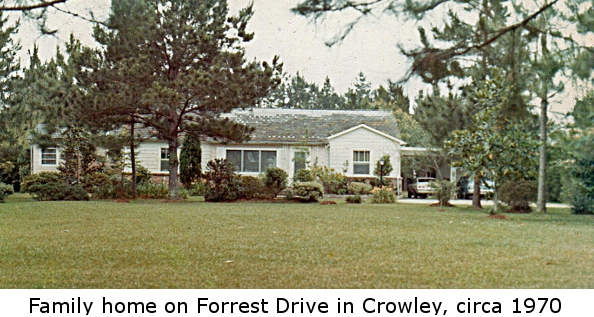
About 1958 we moved out of town. Cellie and Al had bought an acre of an old rice farm off Forest Drive that was being being developed for homes. This was about two miles north of Crowley, a block west of Hwy 13, two blocks north of I10, and a quarter mile east of Bayou Plaquemine. They bought a local house, moved it on site, and then added on with lumber from the Prieto family mill in Mandeville. The carpenter complained about how "hard" the Mandeville wood was. There were about 20 acres of woods adjacent to Bayou Plaquemine. I never met the owner but I had a great time camping and roaming in those woods with my dog Freckles and the neighborhood kids. It was at this time that my love for animals manifested itself. Seeing a dead dog on nearby Hwy 13 would leave an image in mind that I could not escape. At night I would leave the house, retrieve the body and bury it, feeling guilty at being tender-hearted. Mike Rasmussen lived next door and we became good friends. And just on the other side of Hwy 13 was a tangerine orchard which Mike and I and the Cart kids would raid nightly when they were in season. I was eventually caught by the owner and he was not amused. I can remember what seemed to be a foot of snow falling one Christmas, and I can still visualize Freckles happily bouncing through the snow with only his stub tail and nose sticking out. What a wonderful place to hang out.
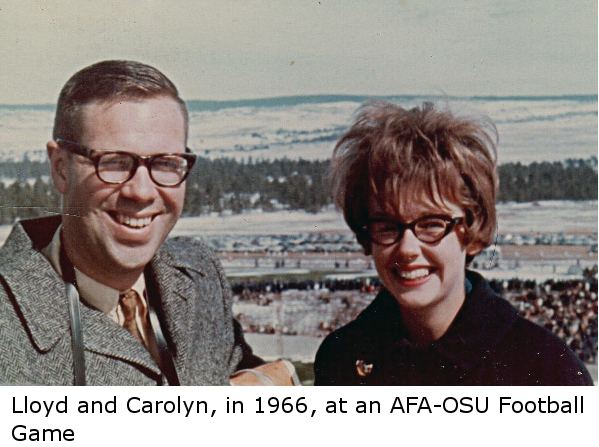
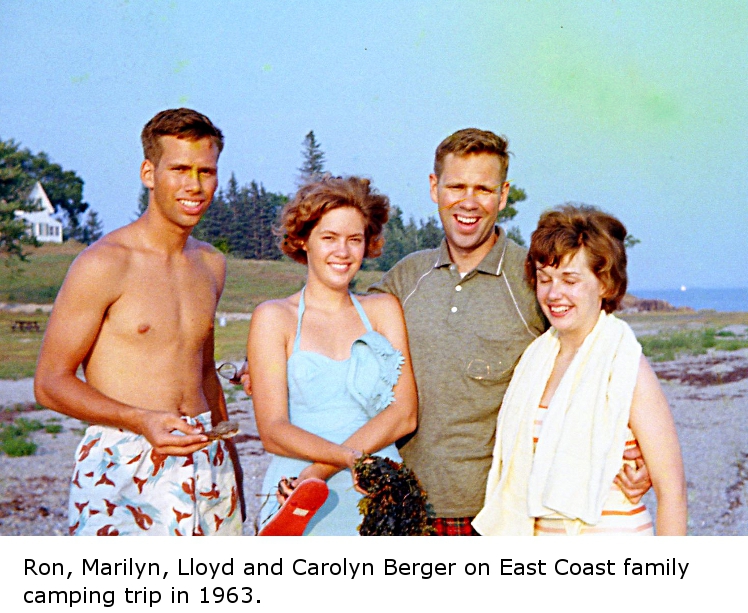
After graduation, in 1962, he went to Cornell for graduate work in physics on a National Science Foundation Fellowship, receiving his M.S. in physics in 1964. Lloyd was and is, I think, one of America's best. He married Carolyn J Bergen, a fellow graduate student at Cornell who received her M.S. in home economics that year. Carolyn was of Norwegian background and was from Coos Bay on the Oregon coast. I thought her younger sister Jeannie was the "cat's meow." She was studying to be a marine biologist - not sure if she ever became one. Unfortunately, Lloyd's marriage with Carolyn only lasted a few years.
But as I think back, I realize how fortunate I was to grow up in a Mayberry-kind of town like Crowley. We were protected from our misdeeds. I remember once in high school shooting a policeman with a water pistol as he directed traffic. Marilyn was driving and the cop actually tracked us down later and confiscated the water gun (lol). But he wasn't even angry. It was and remains a great place to live.
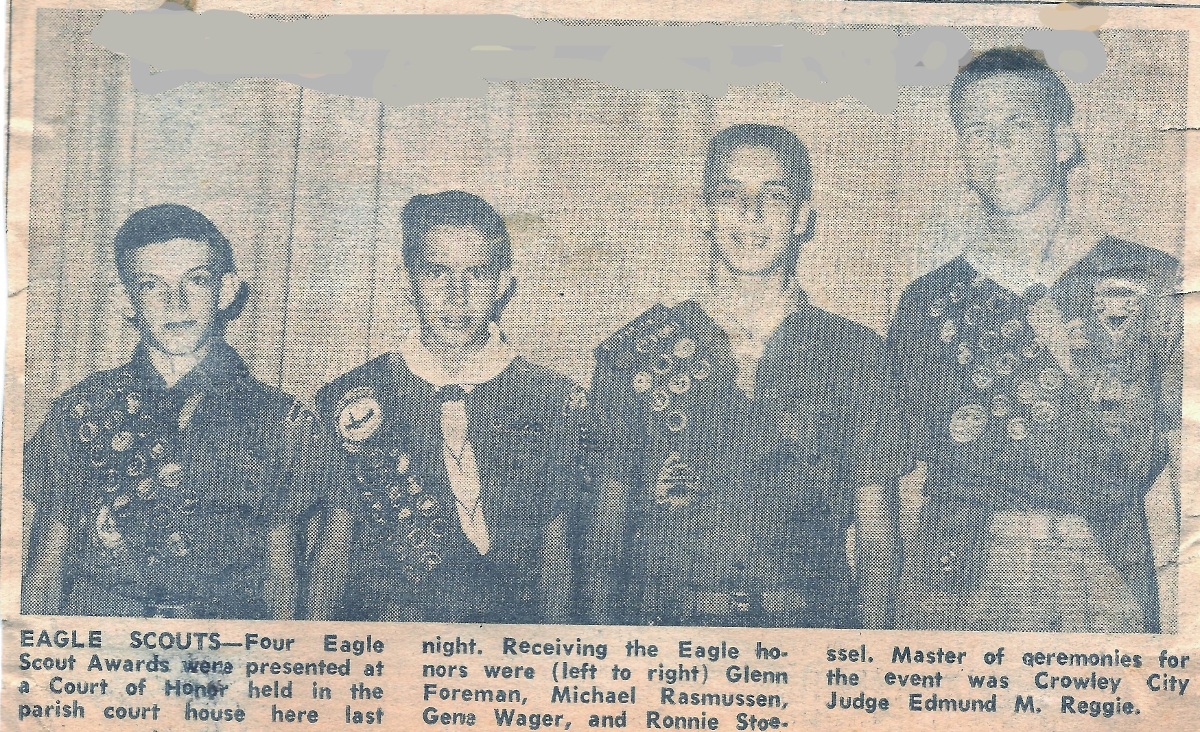
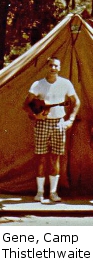
I want to mention the Scouts again. I started out as a Cub Scout, then a Boy Scout (Troop 7), and finally as an Explorer with the same group of guys, so we were all good friends. Th grainy newspaper picture was provided by Mike Rasmussen for when we made Eagle Scouts in 1962. Paul Puissegur was our scoutmaster. We often went on camping trips with the usual midnight raids of other troops camping in the same woods. It was just fun. I can still taste roasted armadillo, caught and cleaned (messy job scraping it out of the shell) on those camping trips. Roasted armadillo tastes like roasted chicken, just like all those tasty Cajun treats that could be scavanged, e.g., water moccasins and young gators. During the summers, following my Junior and Senior High School years, I was a Boy Scout Camp Counselor at Camp Thistlethwaite on the banks of Bayou Courtableau near Washington, Louisiana. Gene Wager and I roomed together in one of the camp tents. Malcolm Gott, and other Crowley classmates were also there as counselors, as was Tim LaTour from Ville Platte who later was a geology major with me at LSU. Malcolm was the fastest white guy I ever knew, regularly running 9.7 seconds in the 100 yard dash in high school. At Camp he raced a quarter horse and the horse won, but not by much. Sandy Pinkard was there also, a troubadour on the guitar, who later went to Hollywood as a country singer and song writer. In the backyards of my mind, I can see and hear Sandy struming his guitar and singing Greenback Dollar: "And I don't give a damn about a greenback dollar, spend it fast as I can..."
Camp Thistlewaite was a dream job for me. We lived in tents with wooden floors on the banks of a bayou in a location that had once been an Opelousa Indian Village. We picked up arrowheads after every rain on the bayou banks. The food was great, the pay was terrible ($5 or $10 a week), but who cared. The young scouts would come to take classes to earn merit badges. Their older sisters would come with the families to visit on Thursdays and these were often very pretty girls. I generally taught courses related to the nature merit badge. I use to catch nonpoisonous snakes as teaching aides, and I kept them in a ventilated box with see-through sides and an opening in the top. Now you may not know what a yellow-bellied water snake is, but trust me, this is one mean snake. One afternoon, the young scouts were gathered around me, soaking up my every word about snake identification and reptile biology. I ended by opening the top of the box, saying "Even nonpoisonous snakes can bite so be careful handling them and pointed my finger through the top hole into the box." I withdrew my finger, and the scouts gasped in horror. My finger was covered in blood. That damn water snake bit me, not once but several times, and so quickly I didn't feel it. But it was a very effective class demonstration of what not to do (lol), good practice for me for later years as a professor.